

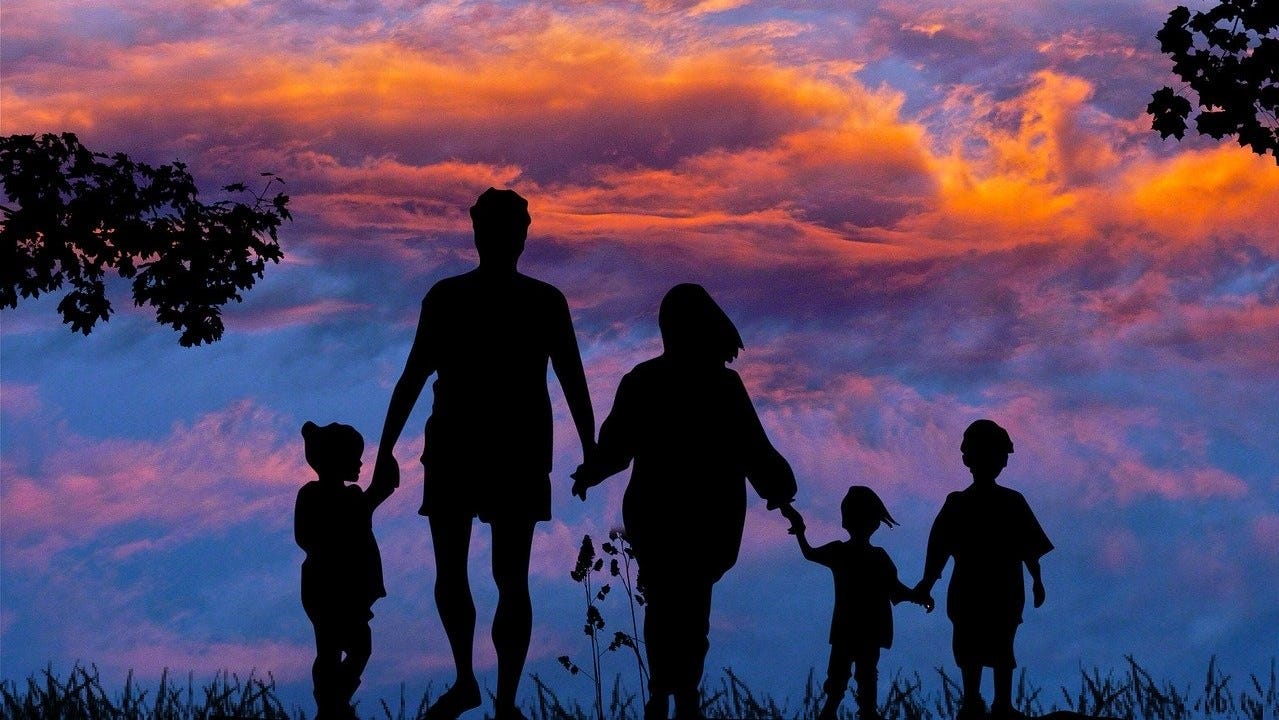
Introduction to Part III: Family
We began our introduction to Catholic social teaching on the ground, by zooming in on the individual person and his dignity. After covering human dignity, many books on Catholic social teaching then zoom out to a great height, to view society from the perspective of national governments, the economy, or national and international politics. I call this the perspective from 30,000 feet. This perspective is extremely important, of course, and we will spend much of this book examining it. However, from 30,000 feet we miss all of the social activity between the individual person and the nation, the economy, and politics. We risk overlooking the social life and social work done by families, neighborhoods, businesses, churches, and other local communities. Our plan is to linger on the ground for a little longer, to get to know local communities better.
Chapter 9
The Truth About the Family
If the person is on the ground of Catholic social teaching, we don’t have to get very far off the ground to find community – the first social part of Catholic social teaching. And the first community we meet is the family – naturally.
Have you ever heard someone say that her school or workplace is “like a family”? Everyone cares for everyone else, celebrates each other’s birthdays and successes, and offers to help and support fellow-workers or student families who are suffering. Some military communities have an extended family feel. Families on isolated military bases are far away from kin, so each family provides practical and social support for the others. It’s not hard to find other examples: local charities, churches, sports teams. Even some criminal gangs describe themselves as families.
Notice that the comparison never goes the other way. No one brags that her family is like a business, or a school, or a military community (much less like a criminal gang!). No family is perfect, but the fact that we praise other communities when they have a family feel is a sign of just how foundational family is to society. It’s also a sign that we expect a lot from the family: mutual support and care, a place to grow in love and responsibility. Each family is called to be “a community of life and love,” according to St. John Paul II.
Families have always struggled to make ends meet, to raise children well, to support each other in sickness, suffering, and loss. These struggles haven’t disappeared, but today families face an additional, more fundamental threat. The value of the family itself has been called into question. Many in our culture doubt that basic conditions for family life – lifelong commitment between a man and a woman and the self-evident goodness of having children – are possible, or even desirable.
In the United States, the evidence of the stress on families is undeniable. Many marriages end in divorce. Fewer young adults enter into marriage. Married couples are having fewer children. A growing number decide to have none. A majority of babies are born into households without a father present. The law now recognizes the union of two men or two women as a marriage, and children are born and adopted into these unions. Governments increasingly evaluate families as if they are nothing more than social service providers for the state. Many government authorities are suspicious of families when they demand a say in the education and healthcare of their children, or who insist on respect for their religious life and commitments.
Much of the modern confusion about marriage arises from deep disagreements about what family is – about the unique purpose of a family. We can no longer take for granted that people (even Catholics) know what a family is, and why family is crucial for a healthy society. In the face of this confusion, Catholic social teaching reminds us of the truth of marriage, and its importance. The teaching on marriage is part of what Pope Benedict XVI called “a mission of truth to accomplish, for a society that is attuned to man, to his dignity, to his vocation” (para. 9). This chapter will review why the family is so important, and the foundational role it plays in society. Chapter 10 will focus on the spouses (whose commitment sustains the family). Chapter 11 will focus on children (who are the fruit of married love, and a great benefit to their parents and to everyone else).
The Family is a Natural Society
The person is naturally social – and what could be more social than the family? The family has been a natural reality throughout human history: each of us was born into a family. A large majority of us start families (or want to). Before we are workers, citizens, students, married couples, or retirees, we are members of a family. When someone loses a connection to his family, because of death, divorce, or the absence of his parents, we treat the missing family connection as a tragic loss. We agree that something has gone terribly wrong.
Why is the family important for society? Most basically, families provide people. Every other community and institution in society – businesses, nations, charities, churches – depends on the family to provide a critical ingredient for success – people. Historically sharp declines in birth rates in both rich and poor countries are forcing nations to confront the effects of declining populations on economies and social services.
Families don’t just produce people – they raise them to be mature adults. The Vatican II pastoral constitution Gaudium et Spes assigns a critical role to the family in preparing people for participation in the broader society. It is the first form of communion, a “school of humanity.” Families are training grounds for virtue. The law of the family is not “every man for himself,” but “the law of self-giving love,” according to St. John Paul II. In families, children experience unconditional love and sacrifice from their parents. As they grow up, they in their turn learn to love and sacrifice for others in the family, and with the family to love others outside of the family.
You don’t have to be Christian, or even religious, to recognize that the natural family is an important foundation of society. Very different cultures share a common experience of the importance of family. This common sense is supported by research. There’s no shortage of studies documenting what happens to children when families break down. Children who lack a stable family are more likely to do poorly in school, more likely to suffer depression and loneliness, more likely to get in trouble with the law, and less likely to begin their own families.
The Family and Grace
Catholic social teaching affirms the natural value of the family, but in Catholic teaching the family is much more than a natural institution. In God’s generous plan, grace perfects nature. Marriages are caught up in the divine drama of salvation and sanctification. In the beginning, God made man in His image – “male and female He created them.” He then commanded them to “be fruitful and multiply, fill the earth and subdue it.” Moreover, family relationships provide rich images of God’s relationship to his people. The Father welcomes the prodigal son. God’s relationship to Israel and God is like a marriage. Jesus (who taught us to call God “Our Father”), asserted that his brothers and sisters were those who hear the word of God and do it. The sacrament of marriage transforms natural marriage into a divine vocation, and is a source of specific graces to help spouses to live out their calling.
Family, Become What You Are!
Because healthy families are crucial to a healthy society, and are under stress, the flourishing of family life is a primary concern of Catholic social teaching. One of the reasons our tour of Catholic teaching begins on the ground, with the person and the family, is to avoid seeing the family as primarily a policy problem. Of course, we should care about policy – about how the law treats families in distress, how foster care and adoption serve vulnerable children, for example. We should ask whether taxes, government policies on education, welfare, and the workplace make it easier or more difficult to raise a family.
Government policy can support families, but government policies cannot raise a family. Families are raised on the ground by parents, relatives, and friends, not from 30,000 feet. Consequently, the most important social work of lay Catholics is the work of forming and maintaining their own families, and supporting other families.
Catholics should lobby for better family policies, but their first responsibility is their own families. John Paul II, in the apostolic exhortation Familiaris Consortio, encourages each family to live up to its vocation:
Each family finds within itself a summons that cannot be ignored, and that specifies both its dignity and its responsibility: family, become what you are (para. 17).
This advice sounds a little odd – “be what you are” – but it isn’t, really. We can forget who we really are. Amid the modern confusion about what a family is, John Paul II reminds us about God’s calling to families, and urges us to try to live up to that divine calling, with God’s help.
The vocation of the family can be simultaneously inspiring and discouraging. It is inspiring because families can do so much good in society. It is discouraging because we know how imperfect our own families are. This tension between our inspiring calling and our imperfections is a common feature of the Christian life. God knows our condition; he calls us to do the best we can and then to leave the rest to Him. Even small improvements can yield great spiritual and practical benefits. For example, when siblings who haven’t spoken to each other for decades find a way to reconnect, however imperfectly, God blesses their efforts. Our work in starting and nurturing family life, and in healing the wounds in our families, is central to the Church’s social mission.
In the next chapters we will examine the Church’s teaching on what a family is, focusing first on the marriage itself, and then on the children.